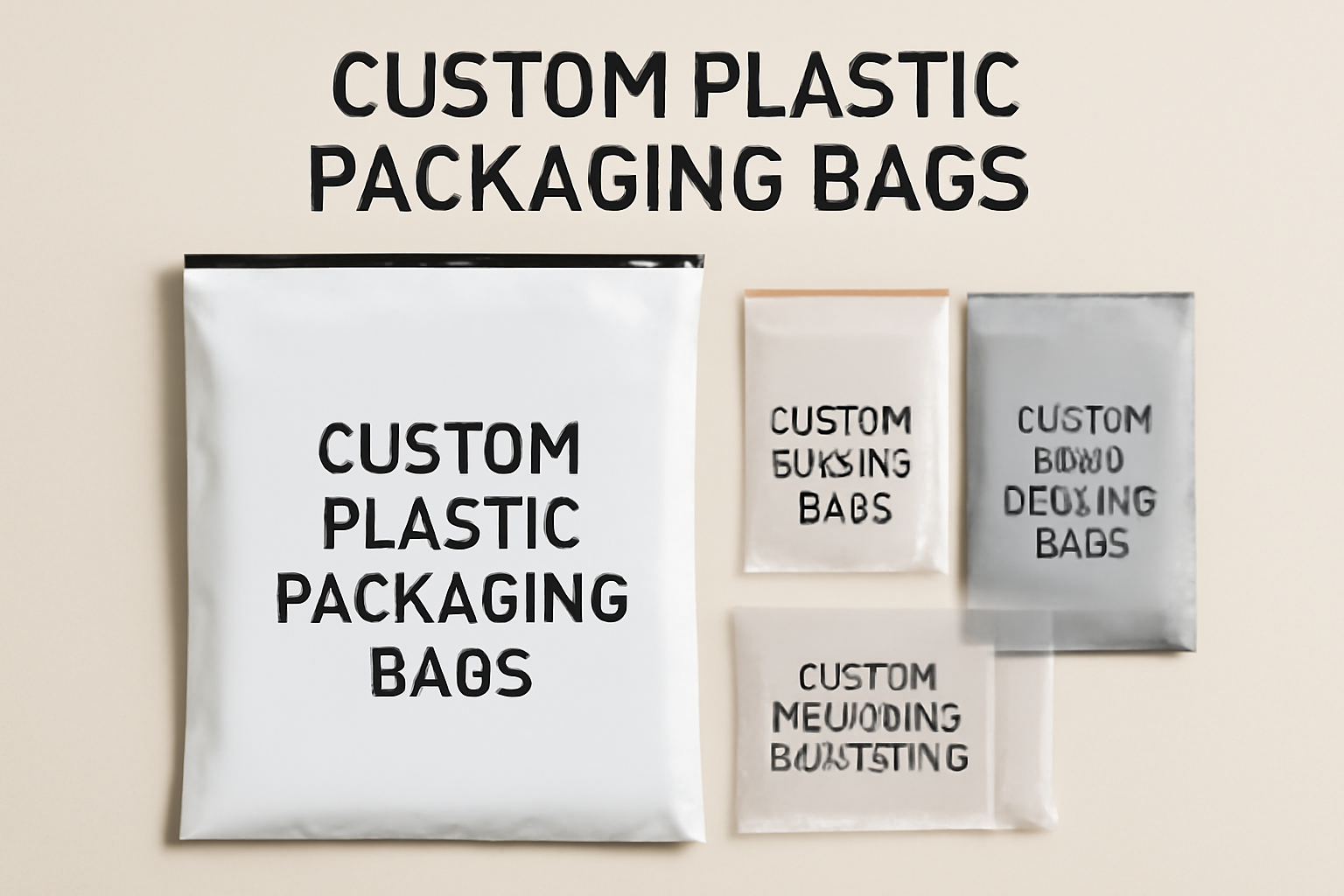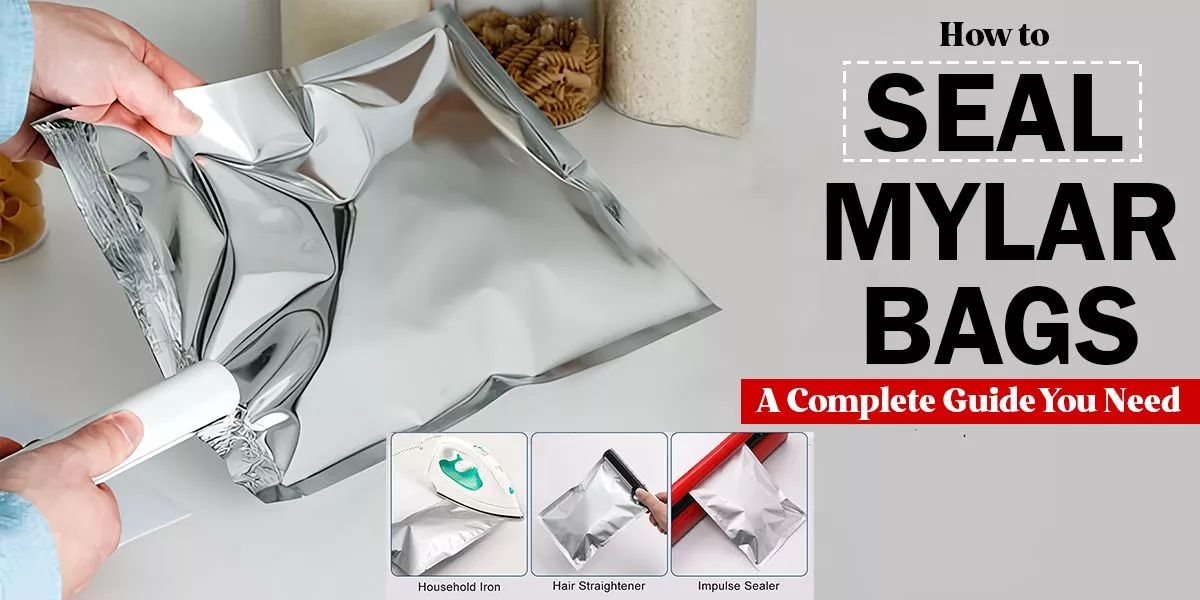
Choosing the right packaging for your product involves more than putting your logo on a bag. The pouch needs to protect its contents, fit your filling process, look professional on the shelf, and stay within your packaging budget.
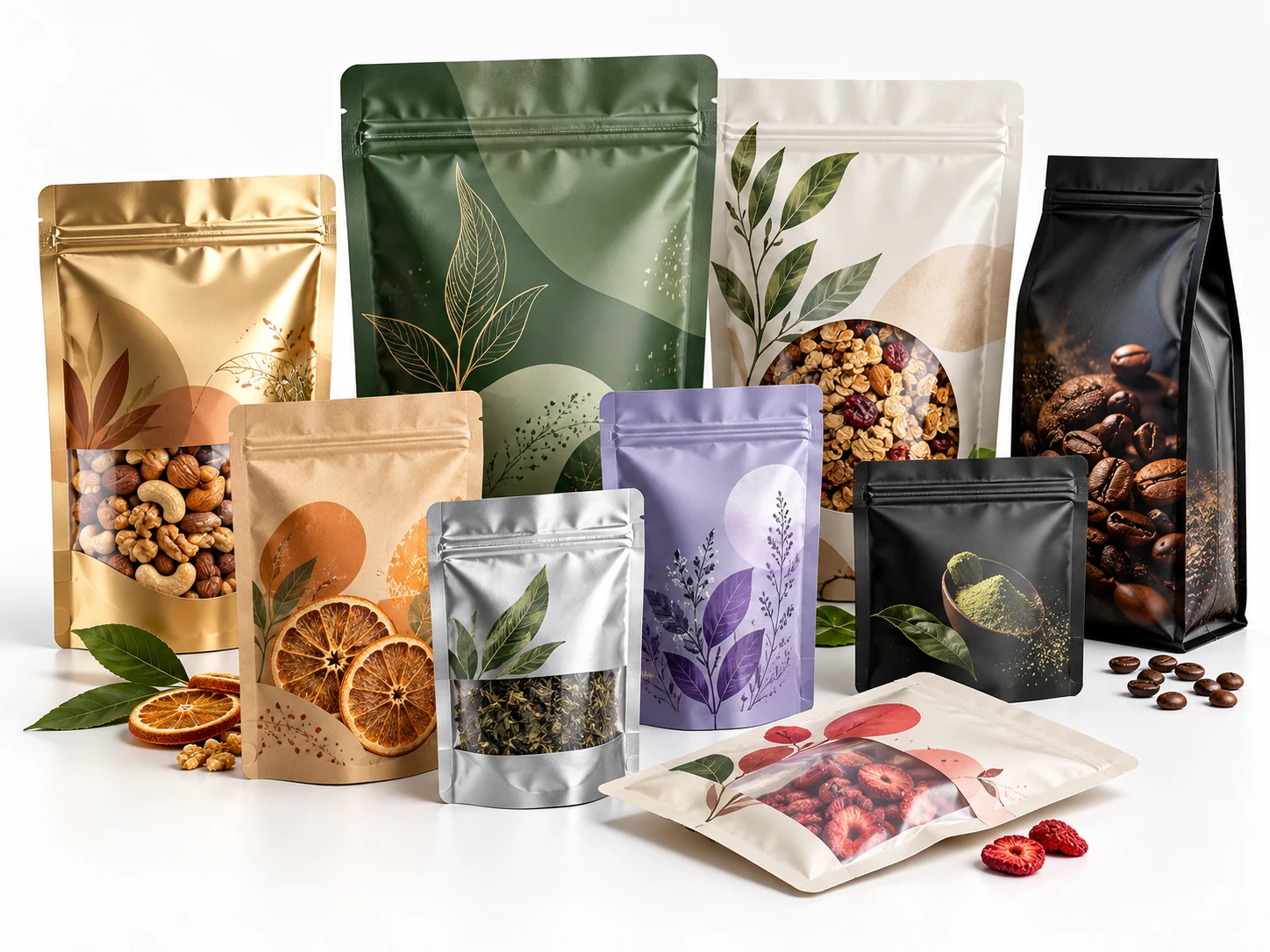
For many food and consumer product brands, custom printed Mylar bags offer a practical combination of barrier protection, flexible construction, and branded presentation.
However, not all Mylar bags are made with the same materials or designed for the same applications. Two bags may look nearly identical but perform differently when exposed to oxygen, moisture, handling, or changes in temperature.
Before placing a custom packaging order, it helps to understand the available materials, pouch sizes, thicknesses, printing methods, and supplier requirements.
This guide explains how to choose custom Mylar bags that match your product and business needs, whether you’re launching a new brand or sourcing packaging for an established product line.
What Are Custom Printed Mylar Bags?
Custom printed Mylar bags are flexible packaging pouches that use polyester-based film, typically as part of a laminated structure, with custom graphics printed for a particular brand or product.
Mylar is originally a brand name for a type of biaxially oriented polyethylene terephthalate (BoPET) film. In everyday packaging terminology, however, “Mylar bags” often refers to various polyester-based barrier pouches, including metallized and aluminum-foil laminated structures.
This distinction matters because polyester film alone does not provide the same oxygen, moisture, and light protection as every high-barrier laminate.
The performance of a finished bag depends on its complete material structure.
Businesses commonly use custom Mylar packaging for products such as:
- Coffee beans and specialty tea
- Nuts, dried fruits, and snacks
- Spices, herbs, and seasonings
- Powdered supplements
- Pet treats
- Freeze-dried and dehydrated foods
- Other moisture- or oxygen-sensitive products
Depending on the packaging requirements, bags can be customized with different sizes, shapes, printed graphics, zippers, tear notches, and other functional features.
The right combination depends on what you’re packaging and how the finished product will be stored, distributed, and used.
1. Start With Your Product’s Packaging Requirements
Before comparing suppliers or printing options, identify the conditions your packaging needs to handle.
A bag for roasted coffee beans has different requirements from one used for powdered supplements or freeze-dried fruit.
Consider the following questions:
- Is the product sensitive to moisture or oxygen?
- Does it need protection from light?
- Is it oily, sharp-edged, or prone to puncturing the film?
- Will customers open and close the package multiple times?
- Does the product require a particular filling or sealing process?
- What shelf life are you targeting?
- Will the product be shipped internationally or stored in changing environmental conditions?
For example, roasted nuts may benefit from stronger oxygen protection to help limit oxidation. Powdered foods may need effective moisture barriers and seals that resist contamination from fine particles.
A brand selling freeze-dried food may prioritize moisture protection, package integrity, and storage durability.
Understanding these needs first allows you to compare custom Mylar packaging based on performance rather than appearance alone.
2. Choose the Right Mylar Bag Material Structure
One of the most important decisions is selecting the correct film construction.
Many custom Mylar bags use laminated films that combine several materials, each providing a different function.
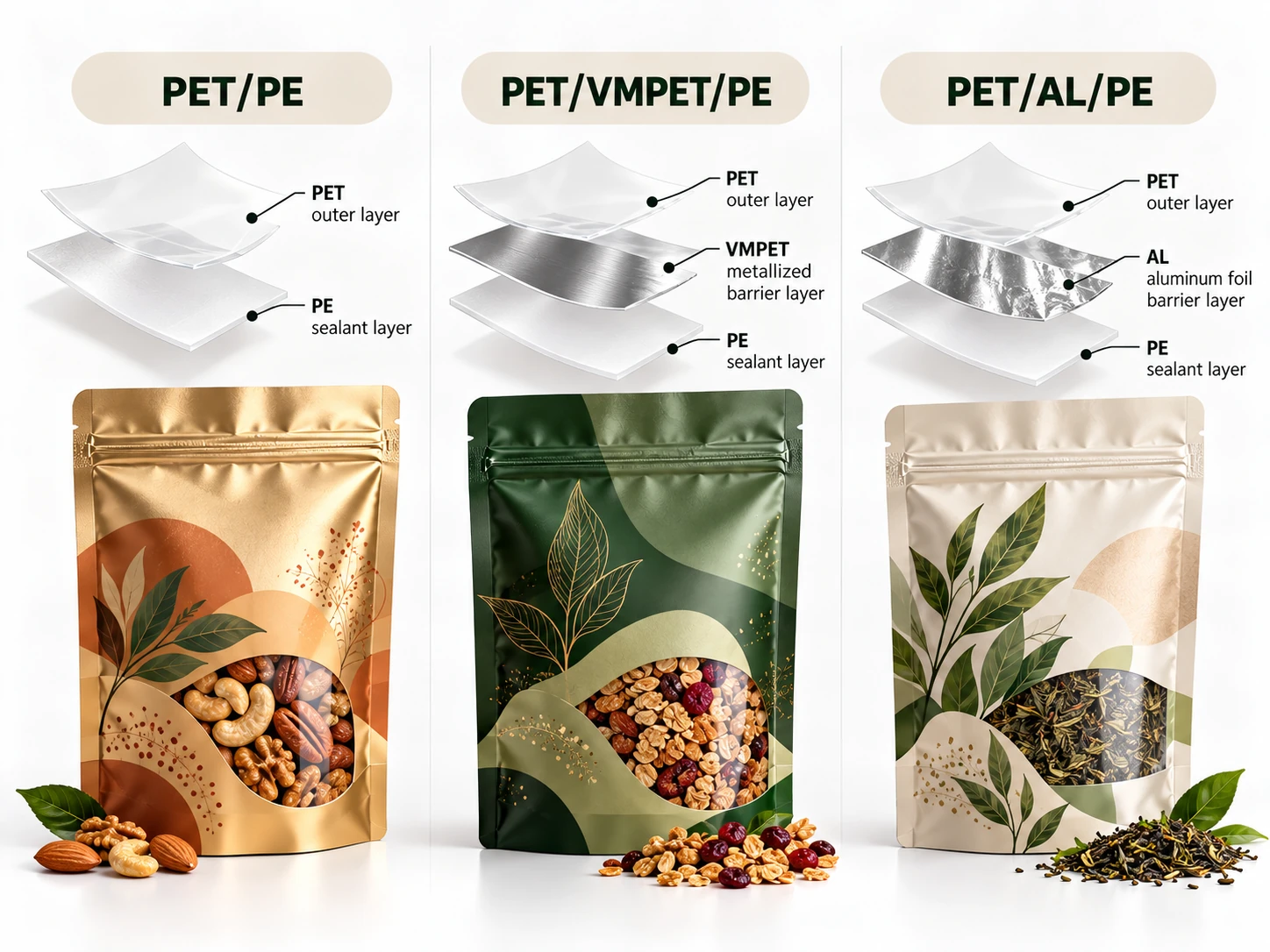
PET/PE Laminates
PET/PE structures combine a polyester outer layer with a polyethylene-based sealant layer.
PET generally supports dimensional stability, mechanical strength, and print quality, while PE provides heat-sealing functionality.
These structures may be suitable for applications that do not require extremely high oxygen or light barriers.
Actual performance depends on film grade, thickness, and any additional coatings.
PET/VMPET/PE Laminates
VMPET is metallized polyester film with a thin deposited metal coating.
When combined with suitable outer and inner films, it can provide improved barrier performance compared with some non-metallized structures.
Metallized laminates are used for various dry foods, snacks, and products that require protection from environmental exposure.
However, barrier performance should be confirmed through film specifications rather than judged solely by the shiny appearance of the material.
PET/AL/PE Laminates
PET/AL/PE structures incorporate an aluminum foil barrier layer between polyester and polyethylene-based sealing layers.
Foil can provide excellent protection against oxygen, water vapor, and light when the laminate remains intact.
This makes foil laminates an option for highly sensitive products and applications that require strong barrier properties.
However, foil-containing structures may have different flexibility, cost, and recycling considerations from metallized alternatives.
Comparing Common Structures
| Material structure | Main characteristics | Common considerations |
|---|---|---|
| PET/PE | Printable, heat-sealable laminate | General packaging with moderate barrier needs |
| PET/VMPET/PE | Metallized barrier structure | Dry foods, snacks, aroma-sensitive products |
| PET/AL/PE | High-barrier foil laminate | Strong oxygen, moisture, and light protection |
These examples are illustrative. Actual product suitability depends on the complete film specification, test conditions, and intended use.
For food applications, ask your manufacturer about relevant food-contact documentation and the intended temperature and storage conditions.
3. Select the Appropriate Mylar Bag Thickness
Mylar bag thickness can affect package stiffness, handling, puncture resistance, and cost.
Thickness is often expressed in mils or microns.
One mil equals 0.001 inch, or 25.4 microns.
Common nominal thickness ranges include:
| Thickness | Approximate equivalent | General considerations |
|---|---|---|
| 3 mil | 76 microns | Lightweight products and compact retail packaging |
| 4 mil | 102 microns | General-purpose pouches where moderate durability is needed |
| 5 mil | 127 microns | Applications requiring additional stiffness or durability |
| 7 mil | 178 microns | Heavier or more demanding packaging applications |
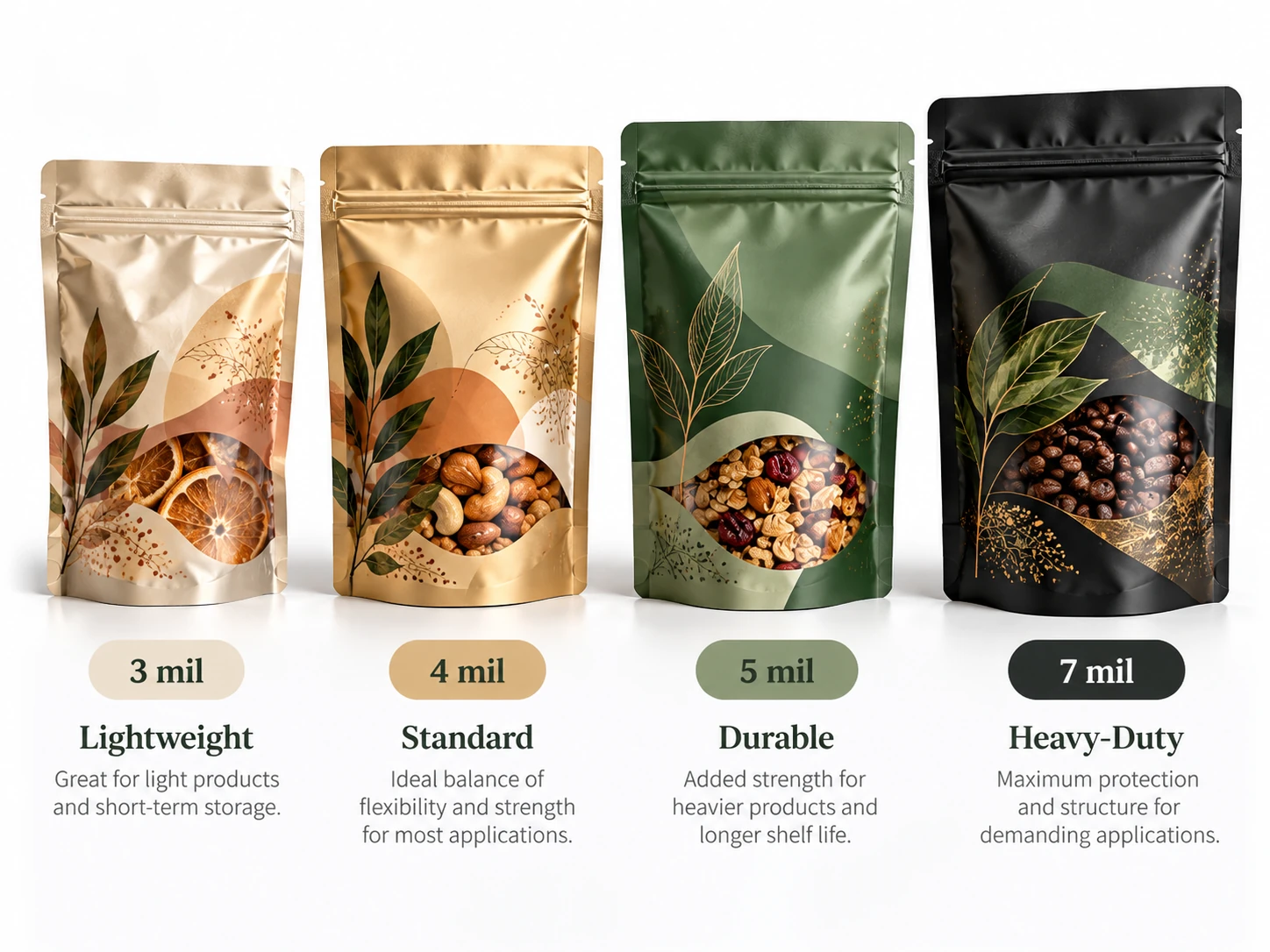
These are reference ranges, not universal rules. A thicker bag is not automatically a better oxygen or moisture barrier.
A thinner foil laminate may provide better oxygen protection than a thicker structure without an effective barrier layer.
Similarly, a thicker film may still puncture if it is unsuitable for a product with sharp edges.
Ask your supplier to recommend a thickness based on your fill weight, product shape, material structure, and shipping conditions.
For a more detailed explanation, read our guide to standard Mylar bag thicknesses.
4. Choose the Best Bag Size and Pouch Style
Selecting the right dimensions is just as important as choosing the right material.
One common purchasing mistake is assuming that bags with the same nominal weight capacity will accommodate every product equally.
For example, 100 grams of whole coffee beans will occupy a different volume from 100 grams of powdered ingredients.
Stand-Up Mylar Pouches
Stand-up pouches use a bottom gusset that allows them to stand upright when filled.
They are commonly selected for retail snacks, dried foods, pet treats, and other products that benefit from visible shelf presentation.
Optional zippers can make them convenient for multi-serving products.
Flat Mylar Bags
Flat pouches and three-side-seal bags have a relatively simple structure.
They can be practical for samples, smaller quantities, and products that do not require a self-standing package.
They may also suit specific filling and sealing systems.
Flat-Bottom Mylar Bags
Flat-bottom bags provide a stable base and multiple panels for branding.
They can be attractive for premium coffee, specialty foods, and larger retail packs.
However, their material usage and construction may differ from simpler pouch formats, affecting cost.
How to Confirm Your Bag Dimensions
Before production, provide your manufacturer with:
- Net fill weight
- Product density or a physical product sample
- Preferred pouch width and height
- Bottom or side gusset requirements
- Required headspace
- Sealing area and zipper position
- Filling equipment details
Whenever possible, test an actual pouch sample with your product before approving the final size.
5. Compare Custom Mylar Bag Printing Methods
Printing determines how your brand appears on the finished package, but different methods have different setup costs and production requirements.
Digital Printing
Digital printing can be useful for brands ordering smaller quantities, launching new products, or managing multiple designs.
It generally offers flexibility for artwork variations without the same printing-cylinder requirements associated with gravure.
For brands testing several flavors or product variations, digital printing may reduce the need for a large initial commitment.
However, available colors, special effects, substrates, and costs depend on the equipment and supplier.
Rotogravure Printing
Rotogravure printing is commonly used for consistent, higher-volume production.
It can deliver detailed graphics and repeatable print quality, but usually requires engraved cylinders and additional setup.
This may make it more economical for repeat orders with sufficient volume rather than small test runs.
Flexographic Printing
Flexographic printing is another option used for flexible packaging.
It can be suitable for various production quantities and substrates, depending on the press setup and artwork requirements.
Its suitability should be evaluated based on print complexity, colors, volume, and total cost.
Choosing the Right Finish
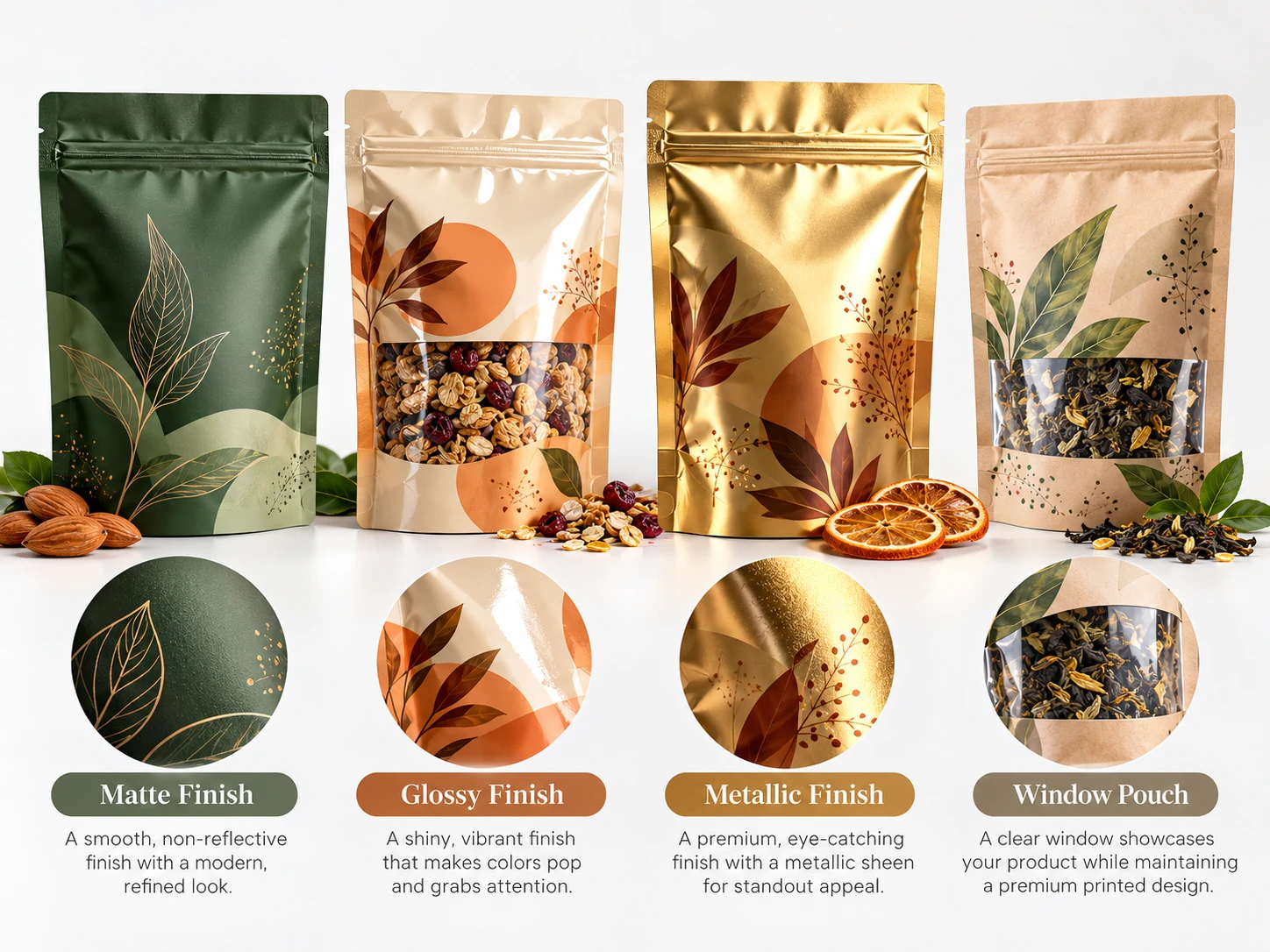
Custom Mylar bag printing also involves selecting the package’s visual finish.
Popular options include matte, gloss, metallic effects, and specialty coatings.
A matte finish may create a more subdued appearance, while gloss can emphasize color and contrast.
The best choice should consider product positioning, handling durability, artwork, and production budget.
Before approving mass production, review print proofs, dielines, barcode readability, and any required product labeling.
6. Consider Zippers, Seals, and Other Functional Features
A well-designed Mylar bag needs to work for both the manufacturer and the end customer.
Common customization options include:
Resealable zippers: Useful for products opened multiple times, such as snacks, coffee, or pet treats. The initial heat seal is still important for protecting an unopened package.
Tear notches: Help customers open packages more easily.
Hang holes: Allow smaller bags to be displayed on retail hooks.
Transparent windows: Let shoppers see the product but may reduce light protection or affect the barrier structure.
Degassing valves: May be appropriate for freshly roasted coffee that releases carbon dioxide.
Child-resistant closures: Required in certain regulated applications, subject to relevant testing and legal requirements. A zipper should not be described as child-resistant without applicable evidence.
Tamper-evident features: Can provide visible evidence of opening, depending on the package design.
Not every pouch needs all these features. Adding unnecessary components can increase cost and complicate production.
Start with the features your product and customers actually require.
7. Understand What Affects Custom Mylar Bag Prices
When purchasing wholesale custom Mylar bags, comparing unit prices alone can be misleading.
Two quotations may cover bags of the same size but use different films, printing methods, and production specifications.
Important cost factors include:
- Total order quantity
- Bag dimensions and film consumption
- Material structure and thickness
- Pouch style and construction
- Printing method and setup requirements
- Number of artwork variations
- Zippers, valves, and specialty features
- Sampling and quality-control requirements
- Shipping terms and destination
For example, a simple flat pouch may cost less to manufacture than a multi-panel flat-bottom bag with a zipper and specialized finish.
Likewise, a metallized laminate and an aluminum-foil structure should not automatically be compared as equivalent products.
Ask your supplier to specify the materials and features included in each quotation.
For a meaningful comparison, request pricing at more than one order quantity using the same technical specification.
This can help identify whether increasing order volume would reduce your overall packaging cost.
8. How to Evaluate a Custom Mylar Bag Manufacturer
Choosing the right custom Mylar bag manufacturer is about much more than finding the lowest quotation.
An experienced supplier should be able to explain the options available and help you avoid packaging decisions that may cause problems later.
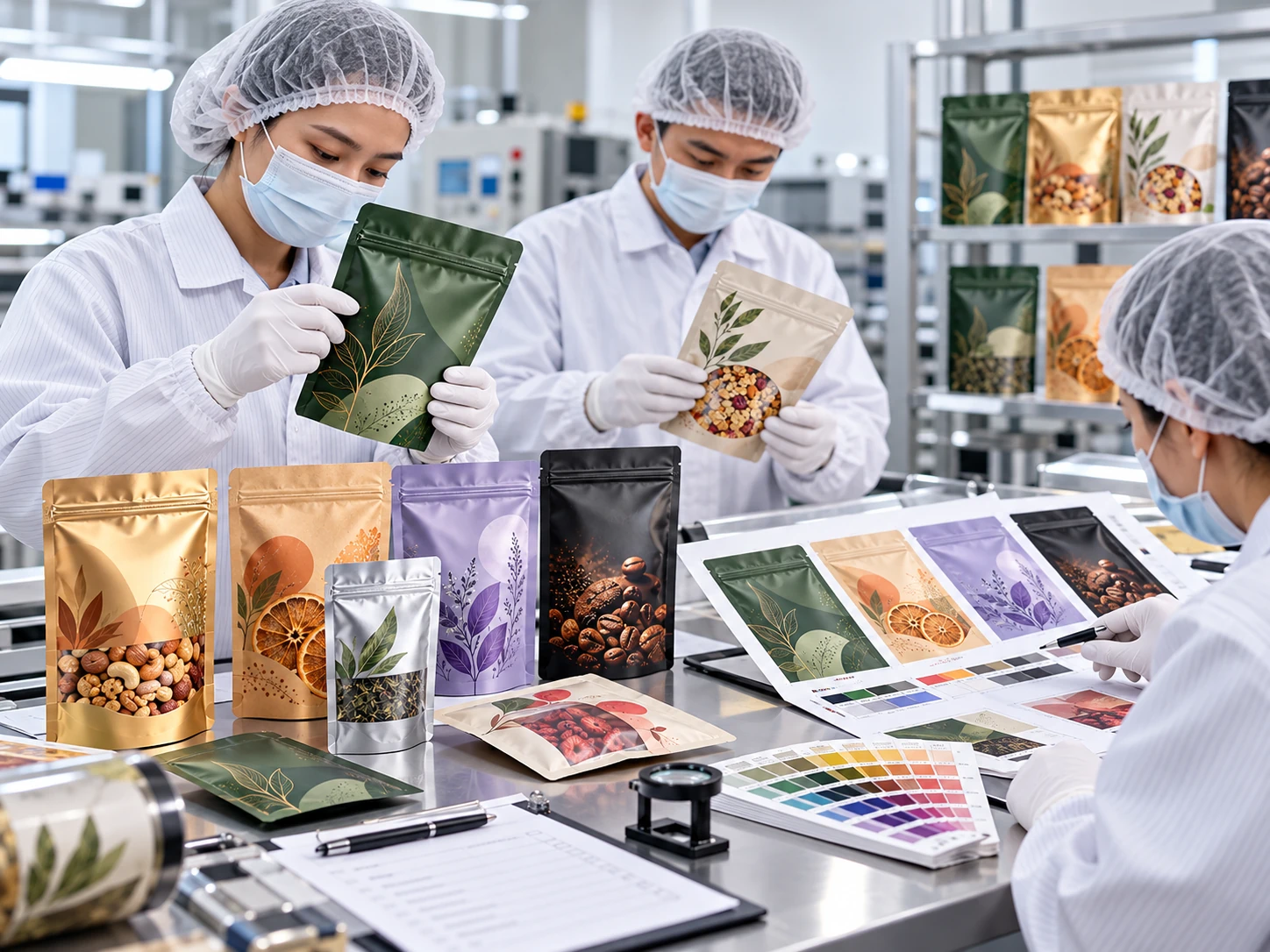
Review Material and Quality-Control Capabilities
Ask whether the supplier can provide relevant film specifications, material documentation, and testing information.
Depending on your application, useful checks may include seal strength, barrier performance, dimensional consistency, and printing quality.
Confirm Manufacturing and Printing Capabilities
Check which pouch styles, printing methods, closures, and material structures the supplier can actually produce.
A company that specializes in standard stock pouches may not offer the same customization flexibility as a manufacturer with its own converting and printing operations.
Request Samples Before Mass Production
Samples help you evaluate the packaging in practical conditions.
You can test pouch filling, sealing, product fit, zipper performance, and the finished appearance.
Where critical performance requirements exist, appropriate testing should be completed before production approval.
Evaluate Communication and Lead Times
A reliable supplier should clearly explain production steps, quotation details, artwork requirements, sampling arrangements, and expected delivery schedules.
Confirm whether the production timeline begins after artwork approval, deposit payment, or another agreed milestone.
Compare Sustainability Claims Carefully
Some manufacturers offer alternative recyclable or reduced-material structures.
However, conventional multilayer Mylar packaging is not automatically recyclable. Any environmental claim should be based on the finished package and the recycling options available in the target market.
Ask for supporting documentation rather than relying on general terms such as “eco-friendly.”
9. What to Prepare Before Ordering Custom Printed Mylar Bags
A complete request for quotation helps manufacturers recommend an appropriate structure and prepare more accurate pricing.
Before contacting a supplier, gather the following information:
| Requirement | Information to provide |
|---|---|
| Product | Food or consumer product being packaged |
| Fill quantity | Weight or volume per bag |
| Bag type | Stand-up, flat, flat-bottom, or other |
| Dimensions | Target width, height, and gusset |
| Material | Preferred structure or required barrier properties |
| Printing | Artwork, finish, and number of designs |
| Features | Zipper, window, valve, tear notch, etc. |
| Quantity | Initial order and estimated repeat volume |
| Destination | Country or region where products will be sold |
| Special requirements | Food-contact documentation, testing, or processing conditions |
If you are unsure about the technical structure, explain your product requirements instead of choosing materials at random.
A qualified manufacturer can help narrow down the available options.
Frequently Asked Questions
Are custom printed Mylar bags suitable for food packaging?
They can be, provided the complete packaging structure uses materials appropriate for the intended food-contact application and meets relevant requirements. Food-contact suitability should be confirmed for the specific product and conditions of use.
What thickness should I choose for custom Mylar bags?
The ideal thickness depends on the product, fill weight, film construction, handling, and distribution conditions. Thicker does not always mean better barrier protection, so evaluate the entire film specification.
Is digital printing better for small Mylar bag orders?
Digital printing is often useful for smaller runs and multiple artwork variations. However, minimum order quantities and costs vary by manufacturer, pouch construction, and finishing requirements.
Can Mylar bags be printed with different designs in one order?
Some printing arrangements can accommodate multiple designs, but minimum quantities, production setup, and pricing may vary for each SKU. Confirm how design variations affect your quotation.
How do I find a reliable custom Mylar bag supplier?
Look for relevant manufacturing experience, clearly documented material options, consistent quality-control processes, realistic production lead times, and the ability to provide samples before a full production order.
Conclusion
Choosing custom printed Mylar bags starts with understanding what your product needs from its packaging.
Material structure, thickness, pouch style, printing method, and functional features all affect the finished bag’s performance and cost. A packaging solution that works well for coffee may not be the right choice for powdered supplements, pet treats, or freeze-dried foods.
Before placing an order, define your requirements, compare suppliers using consistent specifications, and test samples whenever possible.
At Colorful Packaging, we manufacture custom flexible packaging, including printed Mylar bags for food and consumer products. Our team can help you evaluate pouch styles, materials, printing options, and packaging features based on your project.
Explore our custom Mylar packaging bags or contact our team to discuss your packaging requirements and request a quotation.